

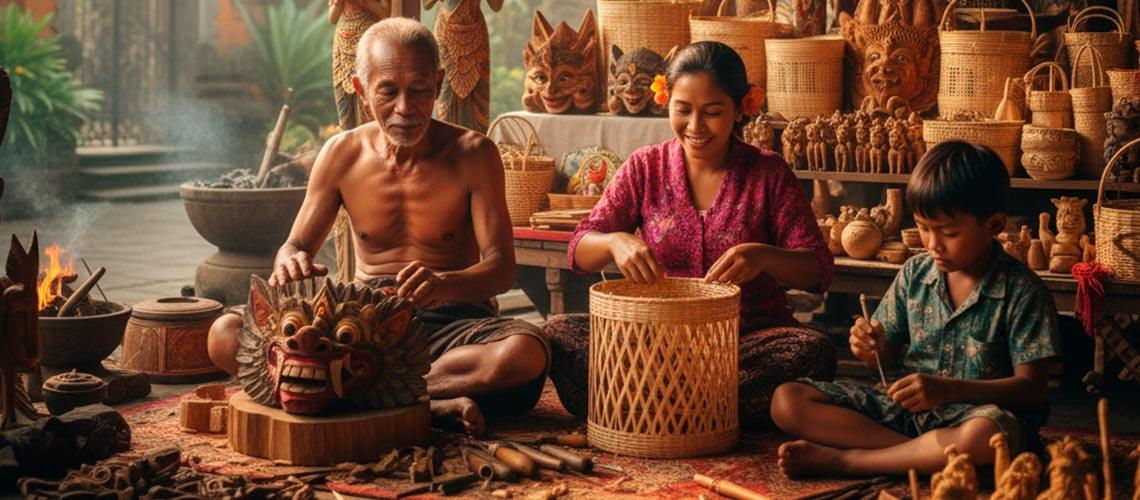
What makes an object truly special? In the fast-paced world we live in, the answer may lie in something seemingly simple: time. Balinese craftsmanship, with its carved sculptures, woven lamps, and baskets made from natural fibers, is a living testament to a time that respects the process, the connection with the material, and the ancestral knowledge that transcends generations. More than decorative objects, these handmade creations reveal the soul of a culture that values the beauty of imperfection, silent dedication, and harmony with nature.
The transmission of knowledge in Balinese crafts.

In Bali, the act of creating by hand is not merely an economic practice, but a spiritual legacy. Artisans begin their apprenticeship in childhood, observing their parents, grandparents, or masters as they carve wood, weave rattan, or gather fibers from nature. This knowledge is not taught in books or formal schools, but shared through patient repetition, daily rituals, and respect for manual work. Each piece is born from a gesture that has been made countless times, but which, even so, is never repeated in the same way.
This transmission of knowledge happens within families or small communities, where learning is collective and continuous. Often, the young artisan begins as an assistant—sanding, washing, or holding the tools—until, over time, they master the techniques independently. That said, it's common for a wood sculpture or a basket to take days, weeks, or even months to complete, precisely because each detail is executed with precision and intention.
Wood sculptures: strength, spirituality, and precision.

Among the most iconic expressions of Balinese craftsmanship, wood carvings occupy a prominent place. Made mostly from woods such as teak, suar, or hibiscus, they represent Hindu gods, mythological figures, protective animals, and spiritual symbols like Barong and Ganesha.
The sculptures can range from small altarpieces to large statues for temple entrances or gardens. The process begins with the selection of the wood—which needs to be cured and dry—and continues with the initial carving, done with simple tools such as chisels, gouges, and wooden hammers. Next, the artisan works on the details: faces, clothing, symbols. The finishing touches can take even longer, depending on whether the piece will be painted, aged, or left in its natural tone.
Producing a sculpture can take from 3 days to 2 weeks, or more, depending on the complexity. More than a craft, carving is an act of meditation and devotion—a work that demands technique, but also spiritual respect for what is being represented.
Explore our category: Balinese Sculptures.
Rattan lamps: intertwining nature and aesthetics.
Another fascinating example of Balinese craftsmanship is the rattan lamps, made from a natural fiber extracted from palm trees in the region. Before being transformed into delicate weaves and sculptural structures, the rattan needs to be harvested, cleaned, and sun-dried for days. Only then is it flexible enough to be hand-woven.
Shaping rattan requires agility and sensitivity. The weaving follows organic forms, often inspired by elements of nature, such as flowers, leaves, or shells. Therefore, the lamps usually have a fluid and natural design, which generates unique lighting effects when lit. Each piece can take from 1 to 4 days to complete, depending on the size and level of detail.
More than just functional, these light fixtures evoke feelings of coziness and belonging—they are like invitations to a sensory rest, where light and matter converse gently.
See all of our handcrafted lamps here.
Baskets made from natural fibers: functionality with soul.

Weaving plant fibers such as bamboo, pandanus, or rice straw is an ancient art in Bali. The baskets, bags, and trays produced by hand reflect a lifestyle integrated with nature. The process begins with the collection and drying of the fibers, which need to be pliable, clean, and free of knots. Then, they are cut into thin strips and braided by hand.
The weaving follows traditional patterns, which often have cultural or spiritual significance. Some baskets are used in religious ceremonies, others in everyday households to store food, objects, or clothing. In all cases, there is a balance between form and function—the basket needs to be sturdy, but also beautiful and well-finished.
The average time to make a basket can vary from 2 hours to 3 days, and often more than one artisan works together in the process. This type of creation values collective work, the sustainable use of materials, and soulful design.
Discover our curated selection: Basketry
The value of time and imperfection in handcrafted work.
Unlike industrial production, where speed and standardization are a priority, in Balinese craftsmanship time is an ally, not an enemy. Each piece is the result of a careful process, where details matter more than haste. Furthermore, imperfection—a slight asymmetry, a variation in color or shape—is valued as a sign of human presence.
This approach reflects a more connected philosophy of life, where beauty and function go hand in hand with respect and purpose. Having a Balinese handcrafted piece at home is therefore more than just decoration—it's inviting ancestral wisdom and care to become part of your routine.
Read also: Conscious Decorating: The Value of Choosing Handmade Items
Tradition that dwells and transforms
Choosing a handmade sculpture, lamp, or basket from Bali means bringing much more than just an object into your home. It's about welcoming a fragment of ancient wisdom, a gesture made with intention, a story that continues to live on. In an increasingly automated world, Balinese craftsmanship reminds us that the human touch still has the power to transform, enchant, and connect.


