


There is much debate about the different types of Buddha and the meanings that the images carry. And although all are capable of stimulating positivity and well-being, wherever they are, the combination of elements that compose them can guide spiritual connection in a deeper way, directed towards a specific intention. In this way, the variation in Buddha iconography will not only be a differentiating factor, but also a guide for certain environments or spiritual, emotional, and physical desires.
Choosing Buddhist art requires understanding the meanings of Buddha , as well as looking at oneself holistically to understand what needs to be inspired by one's image. The inspiration can include healing , fearlessness, peace, abundance, detachment, compassion, wisdom , among many others that change depending on each detail of the sculpture, from the shape of the head to the posture, as listed below!
Buddha's head with ushnisha and ringlet hair or bald.

Usnisa is the protuberance on Buddha's head that characterizes one of his 32 iconographies.
According to passages from the Sutta Digha Nikaya , an ancient Buddhist scripture, the image of Siddhartha Gautama would not differ from that of most monks who detach themselves from material things, and therefore he would be bald. However, this physical characteristic generated cultural conflicts, especially with the Hindu priestly caste, the Brahmins , who do not consider the lack of hair depicted in Buddhist art to be auspicious.
Within this context, the figure of the Zen Buddhist master with wavy hair and a protuberance on the top of his head , the Usnisa or Ushnisha , emerged; as the Indologist and Buddhist Hans Wolfgang Schumann explains in his bibliography. This symbol of the light of knowledge came to the fore in the Gandhara Kingdom , between the 1st and 2nd centuries BCE, with the artistic influence of the Greco-Bactrian Kingdom.
Following this interpretation, iconographic representations of Buddha shed human characteristics and became more deific. And the Ushnisha , in turn, became one of the 32 symbolic iconographies associated with the trajectory of the Historical Buddha . Even so, these evident differences in the visual arts serve to shed light on two views of Buddha : as a human or as a deity.
Types of monastic robes and the branches of Buddhism
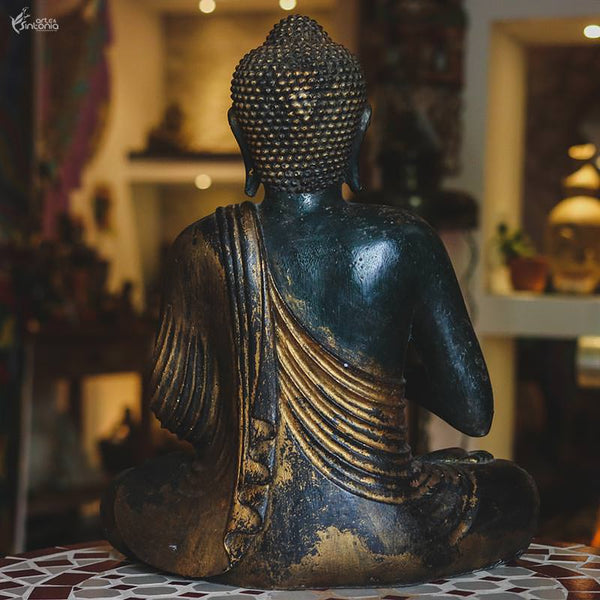
The type of kasaya robe reflects the different schools of Buddhism.
The monastic robes of Buddhist monks , also represented in decorative art with images of Buddha , have undergone changes over the centuries as Buddhism was introduced to different countries. Distinct cultures brought new perspectives to Buddha 's religious philosophy, and new schools were created with particular beliefs and symbolism, although they stemmed from the same origin.
Clothing, therefore, also varied according to the schools of Buddhism . Even so, all present the essence of simplicity, reverence, and selflessness. Clothes made from discarded tattered pieces gave way to those made from donated fabrics during ceremonies like the Kathina . These are dyed with spices ( curry , paprika, cumin, saffron, etc.) that give the well-known yellowish or orange hue.
The traditional monastic robe is called Tricivara or Kasaya , and it consists of three pieces that can be used independently depending on the occasion. The inner garment ( Antaravasaka ) is a type of skirt held up by an 18th-century belt; while the outer garment ( Uttarasanga ) resembles a tunic that covers only one shoulder (usually the right shoulder is uncovered) and is the most characteristic in sculptures ; and the outer garment ( Sanghati ) is a style of cape that covers the left shoulder.
In Theravada Buddhism , dominant in Thailand , Cambodia, and Sri Lanka, monks present themselves simply, following the same Kasaya as Buddha. In Mahayana Buddhism , present in China , Japan, and Korea, they use the Uttarasanga robe with wide, long sleeves due to the climatic conditions. In the Vajrayana Buddhist tradition , which is predominant in Tibet , the clothing of Tibetan monks and Buddhas is more ornate, including embroidery, colorful details, and accessories.
Sculpture of Buddha standing, walking, sitting or reclining.

The seated Buddha is the most represented image in Buddhism and alludes to the state of meditation or teaching.
The posture displayed by Buddha is generally depicted standing, walking, sitting, or reclining (lying down) – although some types of Buddha , especially those in a seated position, exhibit yoga postures ( asanas ). They represent stages of his journey through earthly life until he attained enlightenment. Therefore, when in a standing position , Zen art demonstrates the moment when, after meditating, Buddha rises, ready to teach the Four Noble Truths with his feet firmly on the ground. The decorative sculpture highlights the firmness of the deity and repels internal conflicts.
The walking Buddha is the least common representation, originating from the Sukhothai period , and highlights detachment from earthly ties and the beginning of his journey to enlightenment. Consequently, Buddhist decor featuring this image inspires peace and blessings. The seated Buddha , on the other hand, emphasizes the importance of meditation for spiritual evolution and access to higher stages of consciousness. It is the most reproduced and diverse image of Buddha, whose purpose varies according to the mudra that accompanies it. Virasana , Padmasana, and Lalitasana are some of the most common seated postures.
The reclining Buddha is called Parinirvana and demonstrates the final stage of the life of Gautama Buddha , the Historical Buddha . The reclining or sleeping lion posture ( sihasaiyas ) characterizes the transitional state that precedes the attainment of enlightenment or Nirvana , when one is liberated from the Cycle of Samsara (the continuous flow of birth, old age, sickness, and death).
Image of a fat or thin Buddha

The Fat Buddha refers to Hotei, while his lean appearance embodies Siddhartha Gautama.
It is important to understand that Buddha is not a single figure; the title represents the enlightened nature of the being, which is why Hotei (or Budai ), one of the Seven Lucky Gods , is also called the Fat Buddha or the Smiling Buddha. In Chinese culture, he is believed to have been a Buddhist monk of the Liang Dynasty , whose good humor, magnanimity, and complete contentment led him to attain Nirvana . His large belly is an icon of the great compassion and generosity present in his essence.
The slimmer figure, however, is a portrait of Siddhartha , the Supreme Buddha , whose teachings founded Buddhism and its various branches. In his earthly life, about 2500 years ago, he was a prince who renounced his throne in search of answers to humanity's suffering. This journey of spiritual development allowed him to access divine wisdom, which is present in everything that exists, and to achieve enlightenment. His image in Buddhist art is considered hypostasis , that is, endowed with spiritual powers.
Buddha's hands with mudras or Buddhist accessories.
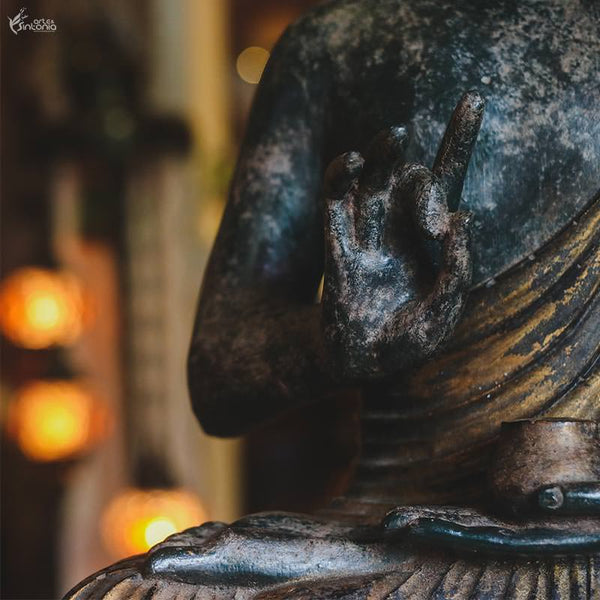
Just like symbolic gestures, Buddhist accessories reveal the meaning of the Buddha statue.
The presence of mudras, as well as postures, marks a moment in Buddha's history and the teachings associated with it. This combination is crucial for identifying not only the type of Buddha that the decorative art represents, but also the energy that vibrates within it. Some sculptures restrict the conception of the hands to symbolic gestures ( mudras ), while others blend them with accessories from Buddhist practice and philosophy – which also reveal paths with their own meanings.
The Medicine Buddha ( Bhaiṣajyaguru ), for example, is depicted holding a medicine pot ( Yakko ) containing the nectar of dharma in one hand, while the other demonstrates the symbolic gesture of gyan mudra . Nevertheless, there is a diversity of Buddhist symbols and accessories represented in the art. The japamala , the lotus flower , the dharma wheel , and the bodhi tree are among the most frequently depicted.
More detailed works and/or those with colorful paintings also help to understand the central message of Zen art . The Medicine Buddha himself is also interpreted with the color blue , relating it to the healing powers and the physical, mental, and spiritual balance provided by his image. Since there are colorful Buddhas of all kinds, from solid colors to artistic paintings , to match your purpose and the decoration of your environment.
Visit our online store and choose a type of Buddha that resonates with you. Let your essence be your guide!
Namaste!
Milene Sousa - Art & Harmony




1 comment
Excelente ! Explicado de forma didática e muito clara. Adorei! Mas tenho uma pergunta: tem imagens de Buda associado aos dias da semana? E por quê?
Namastê!