

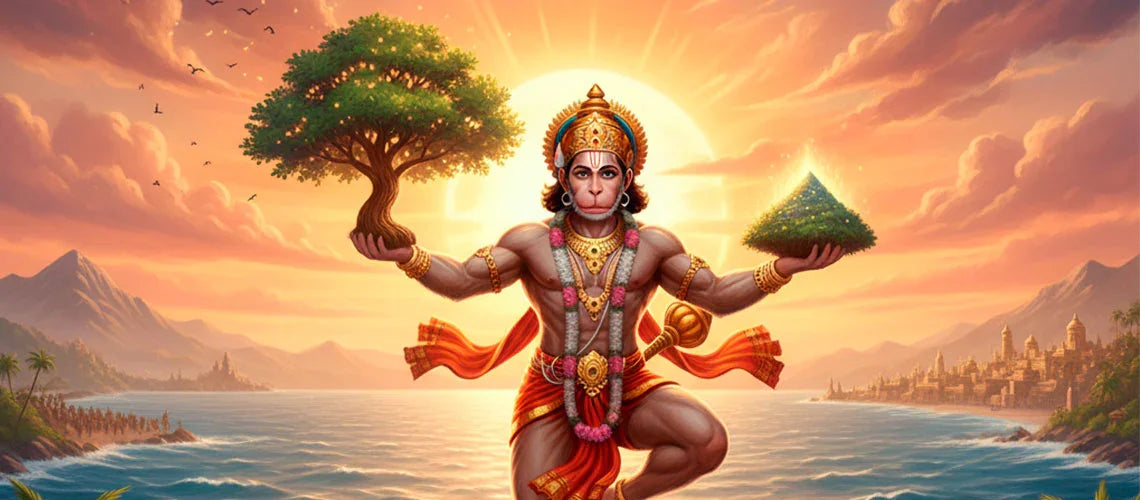
The world of Balinese crafts is deeply intertwined with the spirituality and beliefs inherited from Hinduism. Among the deities and mythological beings represented in traditional sculptures and masks, Hanuman occupies a prominent place. Known as the monkey god, he is revered for his courage, intelligence, and unwavering devotion. His presence in Balinese arts goes beyond aesthetics—it represents inner strength, faith, and overcoming adversity. In this article, we delve into the legend of Hanuman and how his energy materializes in the hands of Indonesian artisans.
See also: Ganesha – Wisdom, Protection and Spiritual Presence
The Legend of Hanuman: The Monkey God of the Ramayana

Who is Hanuman in Hindu mythology?
In Hindu mythology, Hanuman is the son of the wind god Vayu and a central figure in the epic Ramayana, one of the most important narratives in Indian and Balinese culture. According to legend, he was born with supernatural powers—able to fly, change size, and move mountains—gifts granted by the gods as a reward for his purity and faith.
Hanuman is the most loyal ally of Prince Rama, an incarnation of Vishnu, and helps him on his journey to rescue Sita, Rama's wife, who has been kidnapped by the demon Ravana. His courage and loyalty have made him a symbol of true devotion (bhakti) and the spiritual strength that comes from faith. In Bali, this story has been integrated into the local culture and comes to life in dances, rituals, and, of course, Balinese handicrafts.
What does Hanuman symbolize spiritually?
Hanuman represents courage, discipline, wisdom, and unwavering faith. He is considered a guardian against negative forces and an example of humility before the divine. His image, always in a firm posture and with a serene expression, reminds us that true strength comes from devotion and self-improvement. In a spiritual context, Hanuman is also seen as the one who protects homes and wards off bad energies, which is why he is so frequently represented in Indonesian decorative arts. 
Hanuman in Balinese Handicrafts
The syncretism between Hindu mythology and Balinese culture is one of the archipelago's most fascinating features. The stories of the Ramayana are present in temples, theatrical dances, and in the hands of artisans who shape sculptures and masks inspired by these deities. Hanuman appears as one of the most reproduced characters—both in religious pieces and in decorative objects with spiritual appeal.
Click and see our collection: Hindu gods
Why is Hanuman so frequently depicted in Balinese sculptures?
Hanuman is considered a spiritual protector. His image is placed at the entrances of temples and homes as a symbol of courage and purification. For the Balinese, he represents the force that overcomes evil, and his presence serves to balance the energies of an environment. Therefore, it is common to see his image in attack positions (fighting demons) or in meditation (with a calm expression and eyes turned upwards).
Beyond its religious significance, the image of Hanuman also inspires respect for Balinese craftsmanship, as its carving requires great skill and attention to detail—such as the facial features, the ornate garments, and the texture of the monkey's skin.
Where does Hanuman appear in decorations and handcrafted items?

Wooden sculptures: depicting Hanuman in a fighting stance, with detailed muscles and golden adornments.
Traditional masks: used in ritual dances such as Wayang Wong, where Hanuman is depicted with heroic expressions.
Carved panels: depicting scenes from the Ramayana, especially the moment when Hanuman leaps across the ocean towards the island of Lanka.
Small decorative statues: ideal for altars, offices, and meditation rooms, bringing energy and focus.
You might also like: Barong: The Spiritual Guardian of Bali
The Mountain Episode: The Legend that Inspires Artisans
One of the best-known stories about Hanuman tells that, during the battle to save Sita, Lakshmana (Rama's brother) was seriously wounded. To heal him, Hanuman was sent to the Himalayas in search of the Sanjeevani herb, capable of restoring life. Upon arriving, unable to identify the right plant, he lifted the entire mountain and carried it to the battlefield.
This act of extreme strength and devotion is one of the most frequently depicted themes in Balinese crafts. In the sculptures, Hanuman appears supporting a mountain on his head—a symbol of sacrifice, love, and divine power. This scene, carved in wood or volcanic stone, is highly valued by collectors and devotees, as it conveys a message of faith that overcomes any obstacle.
Hanuman as a Symbol of Protection and Inspiration in Decoration
What does it mean to have Hanuman in home decor?
Having Hanuman in your home is more than an aesthetic choice—it's a gesture of spiritual connection. His image represents protection against fear and doubt, bringing inner strength and clarity of purpose. Furthermore, his determined gaze and heroic posture serve as a daily reminder of the importance of faith and discipline in modern life.
In terms of style, Hanuman sculptures and masks blend perfectly with oriental, boho, ethnic, or spiritually inspired environments. Pieces made of natural wood, volcanic stone, or marble add texture, presence, and meaning to the decor, making the space more balanced and welcoming.
Conclusion
Hanuman is more than a religious figure: he is a universal archetype of strength, faith, and loyalty. In Balinese craftsmanship, his presence perpetuates the tradition of storytelling through art, where each carving and each expression carries centuries of devotion. Choosing a Hanuman sculpture or mask brings into the home an energy of courage and balance—a constant reminder that true power lies in surrender and faith.


