

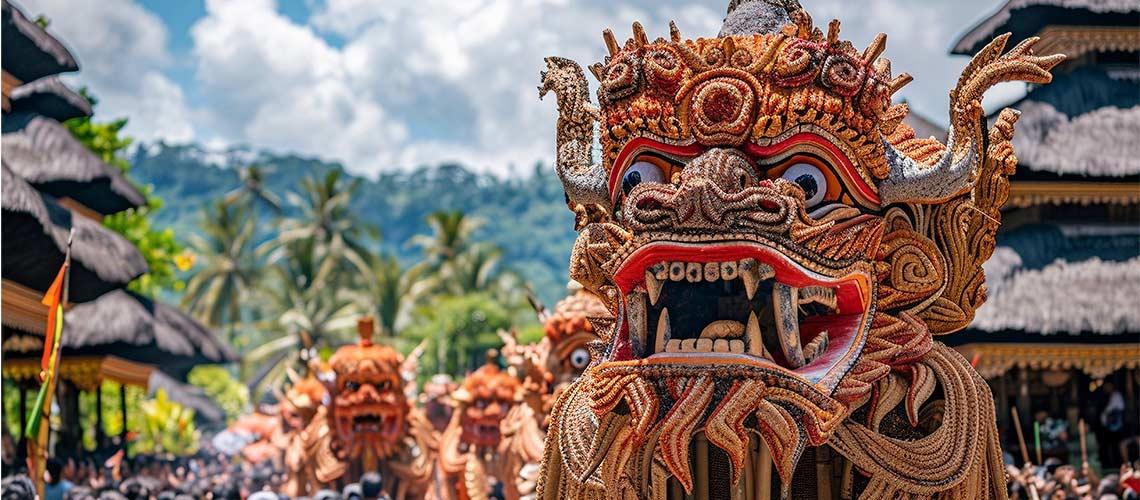
Among Bali's many spiritual symbols, the Barong stands out for its imposing presence, complexity, and profound connection to protection. Considered the guardian of good, it is present in rituals, dances, and sacred sculptures, being an essential figure in Balinese Hindu mythology. In times when we seek more balance and purpose within our homes, understanding the role of the Barong is also understanding how tradition, spirituality, and art intertwine—and how these ancient stories still resonate in our decorative choices.
What is Barong in Balinese mythology?

In Balinese tradition, it is a mythological creature that represents good, the protective spirit of the forest, the village, and the people. It is often depicted as a sacred lion, with large, bulging eyes, sharp fangs, and an elaborate mane—symbolizing the constant struggle between the forces of good and evil, facing the dreaded Rangda, the demonic witch of darkness.
This confrontation is staged in one of Bali's best-known traditional dances: the Barong Dance. The performance, beyond being artistic, is profoundly spiritual, as it invokes protection for participants and spectators. Each movement, mask, and sound carries ancestral meanings, making the guardian not just a theatrical figure, but a living protective sculpture that activates balance on a spiritual plane.
The symbolism behind the Barong mask

The mask, handcrafted by master carvers, is a central element in Balinese temples, ceremonies, and homes. Its appearance may seem frightening at first glance, but each element has a clear symbolic function. The large eyes symbolize vigilance and constant protection, the exposed teeth represent strength against negative energies, and the curled tongue expresses readiness to act.
Furthermore, the mane is usually made of natural fiber or real hair, and the body may be covered with hand-painted fabrics featuring sacred designs. The mask is not an ornament—it is a spiritual object activated by rituals, which must be treated with reverence.
Explore our collection: Decorative Masks .
How does Barong manifest itself in meaningful decoration?
Outside of temples, the mythological being appears in various forms in Balinese culture and is widely used as a decorative element with symbolic value. Sculptures carved in wood — some over 1 meter tall — are common in house entrances, meditation spaces, or hallways, always with the function of warding off negative energies and protecting the home.
Many of these pieces are made from suar wood or reclaimed logs, which further connects the symbol to nature and the ancestral. A protective sculpture of the creature carries with it an energy of presence and grandeur, making it ideal for those seeking a decoration with spirituality, as well as an ethnic touch.
Why incorporate it into the decor?

Including a figure like the Barong in the decor is a way to unite culture, history, and purpose in a single object. Instead of merely beautifying, these pieces transform the space, inviting introspection, protection, and connection with ancient traditions. The Barong is not just beautiful—it is powerful in its essence.
Furthermore, when handcrafted, with hand-carved details, each piece becomes unique, carrying the energy and time of the artisan who produced it. Just as with other Balinese gods, bringing the Barong home is also a way to make room for the sacred in everyday life.
Check out all of our decorative items from the King of Spirits .
What does he represent to the people of Bali?
For the Balinese, the king of spirits is more than a mythological figure—he is a symbol of the people's own spiritual identity. His role in rituals is seen as indispensable, and his image is respected throughout the territory. He represents the duality of life: light and shadow, strength and vulnerability, visible and invisible.
Therefore, when we connect with it, we are not merely acquiring a decorative object. We are accessing a profound symbolic field that speaks of protection, ancestral wisdom, and respect for the coexistence of opposites.
More than art, a present guardian.

Having a Barong in your home is to create a bridge with Balinese tradition, to honor a history that spans generations and continues to live on through art and spirituality. It not only decorates, but also guards, observes, and protects, becoming an active figure in the energetic composition of the home.
In this way, choosing a sculpture or mask goes beyond aesthetics—it represents the desire to live with more meaning, connection, and beauty with purpose.


